BY KYLIE BLABER
 |
| Protesters holding candles walked around an Egyptian Army tank parked in Cairo. Source: Emilio Morenatti/Associated Press |
Researching the Arab Spring turned out to be a little more difficult than I had expected. I sat there, sifting through the surprisingly vast annals of data on the recent uprising in the Middle East and it’s connections to social media, inundated with news articles and opinion pieces on the Arab Spring. Social commentary on the use of social media ran rampant, but the peer-reviewed scholarly articles were few and far between. It was numbers, facts, and proof I was looking for – not conjecture. I wanted to know the precise role social media played in this sudden wave of political movements in the Middle East. With the help of a research librarian at UC Berkeley, I was able to pinpoint my search and find some solid facts. And here’s what I uncovered: social media definitely contributed, but it appears that television, that 20th century ‘traditional’ media, reigned supreme. For the Arab Spring, television proved to be a powerful medium, and yet most analysts have downplayed its importance. I believe, from my research, that it is more an amalgamation of several platforms that deserve credit: It is traditional media’s abundant use of the recent proliferation of social media, thanks to the fervor of the people, as a news source that helped light the spark of the Arab Spring.
“What brought Hosni Mubarak down was not Facebook and it was not Twitter. It was a million people in the streets, ready to die for what they believed in,” –Thomas Friedman, New York Times columnist
What is the Arab Spring? How did it start?
In a piece published in The Washington Quarterly called “The Revolution Will Not Be Tweeted,” Jon B. Alterman writes:
“Part of the problem of comprehending what has happened in the Middle East is that so much of it is new.”1
“Part of the problem of comprehending what has happened in the Middle East is that so much of it is new.”1
This is how I felt in the beginning of my search – it was hard to find a beginning and an end, because everything about this movement is in flux. Things can happen today that could radically alter the available material on the subject, and the novelty of the matter makes it hard to find any reliable, fact-based sources that are less likely to be swayed by money and politics. Mr. Alterman also mentions:
“My own work on Arab media 13 years ago barely talked about domestic politics at all, so hard was it to imagine then that the gathering winds of regional unity would lead to sweeping calls for political change.”1
“My own work on Arab media 13 years ago barely talked about domestic politics at all, so hard was it to imagine then that the gathering winds of regional unity would lead to sweeping calls for political change.”1
The fact that a scholar who has extensively studied Arab media for years prior to this was something I found particularly exciting, because this made the Arab Spring feel like something truly revolutionary.
It cannot be contested that it was in Tunisia where the spark that spread like wildfire through the Middle East was (literally) lit. For more than 20 years, Zine el-Abidine Ben Ali was considered an undemocratic and authoritarian leader. In The Economist's 2010 Democracy Index, Tunisian was classified as an authoritarian regime, ranking a dismal 144th out of 167 countries. 9
Ben Ali carefully monitored Internet use, blocked sites and punished anyone who attempted to bypass them. The Tunisian government was well known for its over-the-top online censorship. In fact, in 2005 Tunisia was the host country for the World Summit on the Information Society in 2005.1 The U.S. government even expressed it’s disappointment in the Tunisian government, issuing a statement that read: “We are therefore obliged to express our disappointment that the government of Tunisia did not take advantage of this important opportunity to demonstrate its commitment to freedom of expression and assembly in Tunisia.”2 In Freedom House’s “Freedom on the Net 2011: Global Scores” chart, both Tunisia and Egypt rank remarkably poor. With the lower the points the better, the USA comes in at #2 with 13 points and a “Free” status. Egypt received a “Partly Free” status with a score of 54, and Tunisia is in the bottom six with a score of 81 – “Not Free.” 3
The Arab Spring began as a sort of domino effect. A young college man named Mohamed Bouazizi, a fruit-seller in a small farming town set himself on fire in December 2010 after being humiliated by the local police force. They confiscated his fruits and vegetables, and Bouazizi lit himself on fire to demonstrate his frustration with the Tunisian government.
In the weeks that followed, thousand of protestors took to the streets all over Tunisia is response to Bouazizi's self-immolation. This led to a chain of events that would lead to the removal of Ben Ali as corrupt leader of Tunisia. On January 14, 2011, after a month of violent protests against his rule, Ben Ali was forced to flee to Saudi Arabia, along with his despised wife, Leila. 9
Not only was Internet usage already heavily monitored in Tunisia but the protests also began in Sidi Bouzid, a small farm town with little Internet access, except to small pockets of techno-savvy citizens. Both of these details highlight the importance of the utilization of both traditional media and social media access in the beginnings of the Arab Spring.
In the weeks that followed, thousand of protestors took to the streets all over Tunisia is response to Bouazizi's self-immolation. This led to a chain of events that would lead to the removal of Ben Ali as corrupt leader of Tunisia. On January 14, 2011, after a month of violent protests against his rule, Ben Ali was forced to flee to Saudi Arabia, along with his despised wife, Leila. 9
 |
Tunisian President visits Mohamed Bouazizi, the man who set himself on fire.
Photo credit:
Hassene Dridi / ho Tunisian Presidency
|
“Tunis is the force that pushed Egypt, but what Egypt did will be the force that will push the world,” -Walid Rachid, member of the April 6 Youth Movement.7
Why did it continue in Egypt?
The movement towards the Egyptian revolt didn’t happen overnight. The following data from Mr. Alterman’s article will help formulate an idea of what fueled the tides of change in Egypt, the country I focused on my social media research on.
- “In the last few years, the Egyptian economy had seen impressive growth, with seven percent in normal years, and approximately five percent during the 2009-2010 global recession. Even so, tens of millions of Egyptians struggled with tight labor markets and rising prices. 1
- By January 2011, Egypt’s youth unemployment rate was 25 percent, and many young Egyptians waited years between when they finished their education and got their first job. 1
- Annual inflation in 2010 was running at approximately 10 percent, with food inflation almost twice that amount—the highest of any country in the world. 1
- Tomatoes, long a staple of the Egyptian diet became unaffordable luxury for many and the price of meat climbed out of reach. 1
- Labor strikes became increasingly common in Egypt, with more than 600 labor actions reported nationwide in 2010. 1
- Other protests in 2010 rippled throughout the country, on issues ranging from foreign policy to domestic detentions to the management of state-run corporations.” 1
Besides this tide of protests in 2010, Egyptians were also becoming increasingly unhappy with their nation’s politics. The November 2010 parliamentary elections saw a landslide for the ruling party, the National Democratic Party (NDP.) After two separate elections, taking place November 28 and December 5, the NDP secured an overwhelming 83 percent majority of seats in Parliament, winning 420 seats. The largest opposition to the NDP is the Muslim Brotherhood, whose seats in parliament dropped for 88 to a mere one representative.4 The elections were also fraught with violence and allegations of fraud. Many saw it as a mere power play by Hosni Mubarak, the reigning president of Egypt for 30 years.
January 25, 2011
“Taghir, hurriyah, ‘adalah ijitima’iyah!”
“Hosni, Hosni bey, kilo lahma bi-mit ginay!”
Chants of protestors in Tahrir Square, respectively: “Change, Freedom, Social Justice,” and “Hosni, Your Excellency, a hundred pounds for a kilo of meat.”1
“Hosni, Hosni bey, kilo lahma bi-mit ginay!”
Chants of protestors in Tahrir Square, respectively: “Change, Freedom, Social Justice,” and “Hosni, Your Excellency, a hundred pounds for a kilo of meat.”1
Several demonstrations had attempted to take flight prior to the events in Tunisia, although none gained ground quite like the Arab Spring. The Kefaya movement was active from 2004-2007 but never gained much support, online or on the ground. Social media did come more directly into play with The April 6 Youth Movement. Utilizing mobile devices and the Internet, the movement was able to successfully organize a strike in March 2008 in Mahalla, Egypt. Following this, one of the co-founders and an activist since nearly 2005, Ahmed Maher created an April 6 Youth Movement Facebook page. Though they were unsuccessful in forming another wide-scale protest until after the Tunisian uprisings, the Facebook page continued to act as a significant forum for social change.
Similarly, 2010, Wael Ghonim, Internet activist and interestingly, the Head of Marketing of Google Middle East and North Africa, started a Facebook group called “We Are All Khaled Said,” in support of Khaled Said, a young Egyptian who was tortured to death by Alexandrian police. According to Wikipedia, Wael made an announcement on the page on January 14, 2011 “asking members if they were going to plan on taking to the streets January 25t and do what Tunisia did?” The same day he published an event called “25 يناير على التعذيب والفساد والظلم والبطالة [January 25: Revolution against Torture, Corruption, Unemployment and Injustice].” 5 It was partially anonymous activists like Ghonim who helped incite and escalate the rapid events that led to the events that would bring down Hosni Mubarak on February 11th, 2011.
“I have never seen a revolution that was preannounced before,” Mr. Ghonim said.7
Inspired by the overthrow of Tunisia’s Ben Ali, the protests spread to Egypt on January 25, 2011, a day declared a “Day of Rage.” Opposition leaders called for protesters to take to the streeta against Mubarak. While exact numbers of protesters could not be estimated, a flood of Internet photographs and YouTube videos showed a massive presence in Cairo, Alexandria, and other Egyptian cities, which helped fuel the fire. These protests lasted 18 days and Internet-savvy protesters used TwitPic, Facebook and YouTube to compile videos and photographs, calling on Egyptians to protest. Protesters provided minute-by-minute tweets concerning where to assemble in an effort to outwit police. The following quote from the New York Times highlights the prominence of social media from the very beginning of Egypt’s protests:
“More than 90,000 people signed up on a Facebook page for the Tuesday [January 25] protests, framed by the organizers as a stand against torture, poverty, corruption and unemployment.” –Kareem Fahim, New York Times
Interestingly, the Muslim Brotherhood sat out on the first day. But by the second day they issued an order for “all able-bodied men to join the occupation of Tahrir Square. The group’s members helped the protesters divide into teams to organize their defense, several organizers said.”7 Initially, the Egyptian government rebuked with episodic censorship. On January 28th, nearly 88 percent of the country Internet access had been shut down, according to networking firm BGPMon. The Mubarak regime also ordered the withdrawal of more than 3,500 Border Gateway Protocol routes by Egyptian service providers.6 This meant that cell phone connections would be restricted, potentially cutting off protestors access to social media websites and outside communication. For example, Yara Adel El Siwi (@YaraElSiwi) tweeted on January 26, 2011: “You who have Twitter and Facebook workin on ur phone, use ‘em to spread words of hope. We won’t let this end here #jan25 was just the start.” 8 That same day, representative from the ruling party, the NDP, was on Al-Jazeera that remarking that the revolt was “unprecedented” and voiced the need for change, stating: “the government needs a nontraditional way of dealing with this,” including “action against corruption, against poverty … [giving] more freedoms.”6
 |
|
Figure 3 illustrates the Internet blackouts in
several Arab countries during first quarter of 2011. Egypt’s blackout lasted for five days, from January 28 – February 2. Source: DSG Arab Social Media Report.11 |
“Protesters continued to defy a nationwide curfew in the early hours of Saturday, as Mr. Mubarak, 82, breaking days of silence, appeared on national television, promising to replace the ministers in his government, but calling popular protests 'part of bigger plot to shake the stability”'of Egypt. He refused calls, shouted by huge, angry crowds in the central squares of Cairo, the northern port of Alexandria and the canal city of Suez, for him to resign.
'I will not shy away from taking any decision that maintains the security of every Egyptian,' [Mubarak] vowed, as gunfire rang out around Cairo.” –David D. Kirkpatrick, New York Times
 |
| Egyptian anti-riot policemen clash with protesters in Cairo. Source: TaraTodras-Whitehill/AP |
 |
| The majority of Facebook users believed that, ironically, the main impact of the blocking the Internet was in fact a positive one, pushing people to become more active and mobilizing creative endeavors to organize and communicate outside of the realm of the Internet, which also opened up greater access to those in smaller farming communities. Source: DSG Arab Social Media Report.1 |
Eventually, unable to break the resolve of the protestors, the Mubarak regime resorted to violence, shooting 45 and killing 2. This finally caused soldiers of the Egyptian military, who had previously been ordered to stay neutral, to react. They shot off their firearms into the air in order to successfully scatter Mubarak’s violent troops.7 Due to the limitations imposed on Internet and mobile device usage, traditional protest tactics had to be used to mobilize some one million protestors for the February 1, 2011 protest in Tahrir Square. Mubarak’s crackdown on social media mediums not only imposed great cost on the economy, but also had the ironic consequence of actually angering many rural Egyptians into joining the opposition. On February 11, amidst unrelenting protests, Vice President Omar Suleiman announced that Mubarak had ceded power.
 |
| According to a public opinion poll conducted April 14-27, 2011 by the US-based International Republican Institute (IRI), an overwhelming 84% of Egyptians approve of Mubarak's resignation. [10] |
Social Media’s Role: The Facts
 |
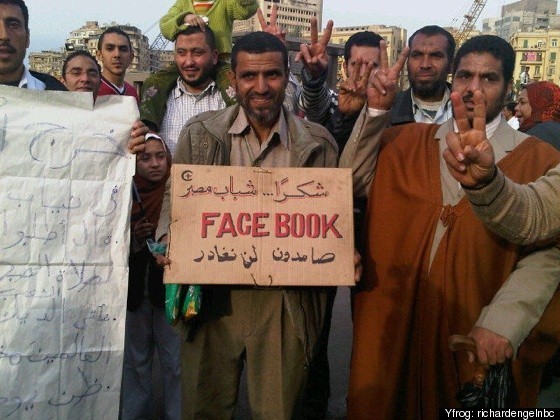
| http://i.huffpost.com/gen/244665/THANK-YOU-FACEBOOK-TWEET.jpg |
“Analysts have not placed enough emphasis on the importance of social media’s enabling people to send content, rather than receive content, transforming them from observers of activism to activists themselves.” –Jon B. Alterman1
The toppling of regimes in Tunisia and Egypt suggested that tools such as Facebook and Twitter were as effective for organizing protests as they were for organizing frat parties. The movements throughout the Arab world appeared to have imbued social media with a sense of legitimacy as a tool for creating change. Social media has clearly helped create an undeniable sense of community, allowing for rapid exchange of information, whether to announce protest sites online or use Facebook to mobilize widespread demonstration efforts, much like the April 6th Youth Movement and “We are all Khaled Said” Facebook page. It also allowed for access to external help. This was especially important in globalizing the problem, as social media’s swiftness and international reach can help amplify local conflicts to a global level. In order to accomplish this, many protestors made an effort to tweet in English or translate Arabic posts, so that the information would be easily accessible to all.
Social media also aided in the problem of state-controlled media and the imposed restrictions on freedom of speech rampant in many of the countries that were prominent in the Arab Spring, allowing young Egyptians like Karim Marold to enter their voice into the political blogosphere without fear of repercussions. 8
Social media also aided in the problem of state-controlled media and the imposed restrictions on freedom of speech rampant in many of the countries that were prominent in the Arab Spring, allowing young Egyptians like Karim Marold to enter their voice into the political blogosphere without fear of repercussions. 8
“boycott: do nt buy the national newspapers for the nxt 3 days, since they r nt covering the whole truth (al ahram, al akhbar, al gomhooria)” – Karim Marold (@karimmarold), January 27, 2011
“The parliament should be able to remove a president and not be removed by one. The president should not be able to change the constitution at all. Governors and mayors should be elected by the people in each circle instead of them being assigned by the president.” -Karim Marold, (@karimmarold), February 21, 2011
Global mobilization also became extremely important for activists in Egypt. Some, like Farah Wael, an Egyptian living in Paris, send out tweets aimed at aiding the protestors with external advice. Wael tweeted the following on January 26, 2011: “In case of arrest call those numbers for legal help : 0123112420 0106574724 0122222672 25310027 Retweet please #25jan #jan25.” 8
Egyptian activists also used social media to form extremely important linkages with organizations online and in person. They communicated with the April 6 Youth Movement, the Progressive Youth of Tunisia, Centre for Applied Nonviolent Action and Strategies (CANVAS), and Otpor, a group from Serbia.
“We shared our experience with strikes and blogging,” said Maher, a leader in the April 6 Youth Movement. 7
 |
| "There was even live broadcasts from the square with people using 3G modems with laptops."http://technosociology.org/?p=448 |
Many of these groups even traveled to Egypt to help train protest organizers, as well as aiding in giving practical advice throughout the protests, such as the following from the New York Times: “Advice to the youth of Egypt: Put vinegar or onion under your scarf for tear gas.” 7
However, many statistics seem to refute social media’s impact, despite its undeniable prevalence. I have compiled statistics from several reliable outlets to fully analyze the impact of social media on social change. “Social media enabled citizen journalists to circumvent the monopoly of state media, resist state censorship, broadcast personal experiences worldwide, and access alternative news sources.” –Barry Wellman, University of Toronto
First of all, the results of public opinion poll conducted April 14-27, 2011 by the US-based International Republican Institute (IRI) dispute any suggested causal effects social media may have had on the events of January 25th. An extremely vast 84% of respondents acquired their information from the television, with word of mouth runner-up. Facebook garnered about 6%, Internet news site about 2% and Twitter barely registered as important at all.
 |
| IRI April 14-27 public opinion poll. Source: http://www.iri.org/sites/default/files/2011%20June%205%20Survey%20of%20Egyptian%20Public%20Opinion,%20April%2014-27,%202011_0.pdf |
 |
| Source: DSG Arab Social Media Report.11 |
The following infographic, also taken from the DSG Arab Social Media report, reflects the growth and prevalence of Facebook in Arab society.
 |
| Source: DSG Arab Social Media Report.11 |
 |
| Source: DSG Arab Social Media Report.11 |
Next, we examine the usage of Twitter in the Arab region during this movement.
 |
| Source: DSG Arab Social Media Report.11 |
Regardless, Twitter clearly made an impact. Over 60% of tweets within the first quarter of 2011 were generated by Kuwait, Qatar, UAE, Saudi Arabia and Egypt in the Arab region.[11] As an occasional Twitter user myself, I can relate to this. It appears to me that Twitter has definitely become more of a newsfeed for me and many of my peers, a way to connect with celebrities, peers, and international and national news on an extremely personal level. I rarely tweet -- rather, I read trending topics, that tend to coincide with current events, as illustrated in the infographic below.
 |
| Source: DSG Arab Social Media Report.11 |
 |
| Source: DSG Arab Social Media Report.11 |
Though perhaps you cannot directly link the current events as the cause for an overall higher tweet volume, Figure 30 illustrates the connection between #jan25 hashtags and actual daily Tweet volume, and I believe the effect is quite clear. In the first quarter of 2011,there were approximately 1,400,000 mention of #egypt and 1,200,000 of #jan25. Any avid or even infrequent Twitter user knows that current events are the absolute crux of Twitter. Twitter is like a real-time current events updater -- if something big happens in the world, and particularly in your own nation, that stuff gets posted!
Overall, I don't think that it is necessarily the importance of how citizens received their content, but rather it was the social media's ability to "enable people to send content, transforming them from observers of activism to activists themselves with a greater stake as leaders, not just followers, of unfolding events." [1]
It isn't numbers or how many people received their content through television or Facebook, but rather the vigor of the Egyptian people to get involved, to make a change. Television took social media and made it accessible to many who may not have been previously aware of it's ability to foment change and create a forum free of oppression in any form -- it was rather the empowering the people to realize that they had a way to get involved, too.
What now?
“As we look ahead into the post-protest period, however, the limitations of social media are becoming even more apparent. Social media are not evidently helpful in facilitating political bargaining in constitution-writing processes, and social media have only played a limited role in helping form new political parties.” –Jon B. Alterman
Egyptians have now voted meaningfully for the first time ever. Things in the Arab world are still in a state of flux, as these events are fairly recent. Kamal Ganzouri currently serves as the Prime Minister, and he appears to have a solid following in his country.
 |
| Source: DSG Arab Social Media Report.11 |
According to IRI’s Egypt survey results
analysis, “the aftermath of the Egyptian revolution survey found that the
people of Egypt are extremely positive about the direction of their country and
overwhelmingly pleased with the resignation of Hosni Mubarak. However, the
state of the Egyptian economy, and security and crime are foremost in the minds
of Egyptians. As a result, the legitimacy of any post-Mubarak government will rest
on the ability of its decision makers to address these issues.”
Let's hope that things continue to stay on the right track for Egypt.
SOURCES:
1: “The Revolution Will Not Be Tweeted” Jon B. Alterman, Washington
Quarterly, Fall 2011
2: “U.S. Delegation Urges Progress in Tunisian Reform, Human Rights,”
November 18, 2005
3: Freedom House, Freedom on the
Net 2011: Global Scores, http://www.freedomhouse.org/sites/default/files/MainScoreTable.pdf
4: Ashraf Swelam, “Egypt 2010 Parliamentary Elections: The Landslide,”
Egypt’s International Economic Forum, January 2011, http://www.yale.edu/worldfellows/fellows/documents/OccassionalPaper2-Egypt2010ParliamentaryElectionsTheLandslide.pdf
8: http://peacemagazine.org/archive/v27n3p06.htm#fn21260358754e0dd1a6d5ed8
9: http://en.wikipedia.org/wiki/Zine_El_Abidine_Ben_Ali
10: http://www.iri.org/sites/default/files/2011%20June%205%20Survey%20of%20Egyptian%20Public%20Opinion,%20April%2014-27,%202011_0.pdf
11: http://www.dsg.ae/en/Publication/Pdf_En/DSG_Arab_Social_Media_Report_No_2.pdf
1: “The Revolution Will Not Be Tweeted” Jon B. Alterman, Washington Quarterly, Fall 2011
2: “U.S. Delegation Urges Progress in Tunisian Reform, Human Rights,” November 18, 2005
3: Freedom House, Freedom on the Net 2011: Global Scores, http://www.freedomhouse.org/sites/default/files/MainScoreTable.pdf
4: Ashraf Swelam, “Egypt 2010 Parliamentary Elections: The Landslide,” Egypt’s International Economic Forum, January 2011, http://www.yale.edu/worldfellows/fellows/documents/OccassionalPaper2-Egypt2010ParliamentaryElectionsTheLandslide.pdf
8: http://peacemagazine.org/archive/v27n3p06.htm#fn21260358754e0dd1a6d5ed8
9: http://en.wikipedia.org/wiki/Zine_El_Abidine_Ben_Ali
10: http://www.iri.org/sites/default/files/2011%20June%205%20Survey%20of%20Egyptian%20Public%20Opinion,%20April%2014-27,%202011_0.pdf
11: http://www.dsg.ae/en/Publication/Pdf_En/DSG_Arab_Social_Media_Report_No_2.pdf

Kylie, this is an extensive analysis! I like the way you use your own Twitter experience to reflect on the way Egyptians may have used Twitter and your argument that the Arab Spring could have played a large role in popularizing social media--instead of the other way around. :)
ReplyDelete